Introduction
When homeowners consider installing solar panels for house use, one of the first questions is usually simple: how much can I save? At Suria & Sonne, the answer always starts the same way — it depends on more than the number of panels on the roof.
Your home’s electricity consumption, roof orientation, available roof space, shading and the size of the solar PV system all influence the return on investment. This is where the type of house matters. A terrace house, semi-detached home and bungalow can have dramatically different roof areas, and more roof space can mean more panels, greater generation and potentially higher savings — but a bigger roof does not automatically guarantee a better ROI. In Malaysia, the smarter approach is matching the solar system to your household’s actual electricity consumption rather than simply filling every available section of the roof.
TL;DR: Key Takeaways
The type of house you live in changes your roof’s solar potential, but roof size alone doesn’t determine ROI — electricity consumption matters just as much. A smaller roof matched to high daytime usage can outperform a larger roof on a low-consumption home.
- Terrace roofs are smaller and often shaded, but still worthwhile for high-usage homes.
- Semi-D roofs offer more flexibility, and electrical phase matters as much as space.
- Bungalow roofs have the most potential, but only if consumption justifies the system size.
- The right system fits the household’s actual usage, not just the available roof area.
Why Does Roof Size Matter for Solar Panels for a House?
Roof size matters for solar panels for house installations because the more suitable roof space available, the greater the potential number of panels that can be installed. However, there is an important distinction between raw roof size and usable solar roof area, since shading, roof structures, water tanks, skylights and unsuitable orientations can all reduce a roof’s actual solar potential.
As a result, two homes with seemingly similar floor areas may have very different solar potential once these factors are taken into account.
Table 1: How terrace, semi-D and bungalow roofs typically compare for solar potential.
| House Type | Typical Roof Space | Solar Potential | Key Consideration |
| Terrace | Limited, often shaded by neighbouring properties | Smaller system, still worthwhile with high daytime usage | Optimisation matters more than raw roof size |
| Semi-D | Larger footprint, more flexibility in panel placement | Can support a larger system for higher consumption | Electrical phase (single vs three) matters as much as space |
| Bungalow | Greatest and most diverse roof area | Highest generation potential | A bigger system only helps if consumption justifies it |
You can view Suria & Sonne’s completed solar projects for examples across different property types.
Terrace Houses: Making Every Square Metre Count
Terrace houses can still benefit significantly from a properly sized system, particularly when the household has relatively high daytime electricity consumption — a family running air-conditioning, washing machines and other appliances during daylight hours can directly use solar-generated electricity instead of purchasing as much from the grid. Rather than asking “how many panels can I fit,” homeowners should ask how much electricity their household actually uses.
Semi-D Homes: More Roof Space, More Solar Potential
A semi-detached home’s larger roof footprint can provide greater flexibility when designing a solar PV system, which becomes particularly useful for households with higher electricity consumption — several air-conditioning units, multiple refrigerators, a dryer, water heaters and perhaps an EV can all push demand considerably higher than a smaller household’s. Under Solar ATAP, domestic consumers can install up to 5 kW for single-phase systems and up to 15 kW for three-phase systems, making the home’s electrical supply configuration just as important as its physical roof size.
Bungalows: The Advantage of Abundant Roof Space
Bungalows often have the greatest potential for solar installation, typically offering larger and more diverse roof areas and greater flexibility in panel placement and system design. However, bigger is not necessarily better — installing a very large system simply because there is plenty of roof space may not produce the best financial return if the household does not consume enough electricity to make use of it.
You can explore Suria & Sonne’s Solar Building solutions to understand how solar PV can be applied to domestic properties.
How Much Can Homeowners Save With Solar Panels?
There is no single savings figure that applies to every Malaysian home, since potential savings depend on monthly electricity consumption, solar PV system size, roof orientation and pitch, shading, household usage during daylight hours, electricity tariff and solar export arrangements. A household spending RM600 a month on electricity has considerably more savings potential than one spending RM150 a month.
For illustration, if solar generation allows a homeowner to reduce electricity expenditure by RM300 per month, that represents approximately RM3,600 in annual savings; at RM500 per month, the annual saving would be approximately RM6,000. These figures are examples rather than guaranteed savings — actual performance should be calculated using the property’s electricity bills, roof characteristics and proposed system design.
Daytime Electricity Usage Can Make a Difference
Solar panels produce electricity during daylight hours, so homeowners who use significant amounts of electricity during the day can directly consume more of the solar energy generated — running air-conditioning, washing machines or dryers during sunny hours can improve the economic value of the system, since the electricity generated is being used exactly where it’s needed. Under Solar ATAP, excess solar energy can also be exported to the grid according to the programme’s applicable energy-offset mechanism.
You can learn more about Suria & Sonne’s solar solutions and the company’s approach to solar PV installation.
Does a Bigger Roof Always Mean Better ROI?
A bigger roof does not always mean better ROI, since a bungalow may have twice the usable roof area of a terrace house without achieving twice the return on investment. ROI is driven by the relationship between installation cost and electricity savings, not roof size alone, so a smaller roof matched to high consumption can outperform a larger one matched to low consumption.
Consider two homeowners: one lives in a terrace house with a high monthly electricity bill, whose smaller roof can still accommodate a suitably sized system that significantly reduces their electricity purchases. The other lives in a large bungalow but has relatively low electricity consumption — despite plenty of roof space, installing a much larger system may not be financially sensible. The best solar system is not necessarily the biggest one; it’s the one that fits the home and its electricity consumption.
Roof Orientation and Shading Matter Too
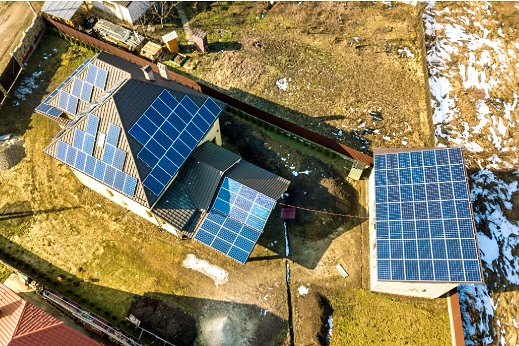
A smaller roof with excellent sunlight exposure can sometimes outperform a larger roof that is heavily shaded, since trees, neighbouring buildings, chimneys and other structures can reduce solar generation, and roof orientation and pitch affect how much sunlight reaches the panels throughout the day. This is why a professional site assessment matters before deciding on a system size.
You can view Suria & Sonne’s solar projects to see examples of completed installations.
How Does Solar ATAP Affect System Planning?
Solar ATAP, introduced in January 2026 as a continuation of Malaysia’s rooftop solar initiatives following the conclusion of NEM in June 2025, allows consumers to generate electricity for self-consumption while exporting surplus to the grid. Current domestic capacity limits are up to 5 kW for single-phase homes and 15 kW for three-phase homes, with larger systems requiring further approval.
This makes proper planning particularly important for larger homes — a homeowner should consider not only how much roof space is available, but also the property’s electrical supply, current electricity consumption and future needs, since systems exceeding the stated thresholds require the relevant Connection Confirmation Check (CCC) approval.
Frequently Asked Questions About Solar Panels for House
Conclusion
When comparing a terrace, semi-D or bungalow, the size of the roof undoubtedly affects the potential of solar panels for house installations — but it’s only one piece of the puzzle. A larger roof provides more opportunity to install panels, but the best financial outcome comes from matching the system to the household’s electricity consumption, available sunlight and future energy needs.
For homeowners, the real question isn’t “how many panels can I fit on my roof,” but how much electricity that roof can realistically help generate and save. With the right system design, even a modest terrace roof can become a valuable energy-producing asset. If you’re considering solar for your home, book a consultation with Suria & Sonne.
Considering solar for your property?
Talk to our team about your electricity use and your roof, and we will recommend a system that fits.