Pengenalan
For Malaysian businesses, electricity is more than another monthly expense — it’s an operating cost that affects profit margins, cash flow and long-term business planning. For factories, warehouses, offices, retail outlets and other commercial premises, rising or unpredictable electricity costs can make energy efficiency an increasingly important business strategy. For companies considering commercial solar services, understanding how Solar ATAP works is the first step towards deciding whether rooftop solar makes financial sense. At Suria & Sonne, this is the question we help business owners work through most often.
With the introduction of the Solar Accelerated Transition Action Programme (Solar ATAP) on 1 January 2026, businesses in Peninsular Malaysia have a new framework for installing rooftop solar photovoltaic (PV) systems while exporting surplus electricity to the grid. Solar ATAP continues the core concept of the previous Net Energy Metering (NEM) programme, but with updated rules and capacity limits.
TL;DR: Key Takeaways
Commercial solar services under Solar ATAP let non-domestic consumers install systems up to 100% of their Maximum Demand, or 1 MW, whichever is lower, and use generated electricity directly before exporting any surplus for a bill offset. Larger systems trigger additional technical assessments, and businesses can choose between outright purchase, PPA and leasing to finance the system.
- Non-domestic capacity: up to 100% of Maximum Demand, capped at 1 MW.
- Systems above 72 kW may require a Connection Assessment Study.
- Installation must be completed and commissioned before the ATAP application is submitted.
- PPA and leasing can remove the need for upfront capital entirely.
What Is Solar ATAP?
Solar ATAP is a government programme designed to accelerate rooftop solar adoption in Peninsular Malaysia, allowing eligible TNB consumers to generate solar electricity for their own consumption while exporting surplus to the grid as an energy offset. Unlike simply installing panels for self-consumption, it gives businesses a structured mechanism to benefit from excess solar generation.
The programme is implemented by SEDA Malaysia, under the regulatory framework of the Energy Commission and the Ministry of Energy Transition and Water Transformation (PETRA).
Who Can Apply?
For non-domestic consumers, Solar ATAP allows a solar PV system of up to 100% of the consumer’s Maximum Demand (MD), subject to technical assessment, with a maximum installation capacity of 1,000 kW. This makes the programme particularly relevant for businesses with substantial daytime electricity consumption, such as manufacturing facilities, shopping premises, offices, warehouses and commercial buildings.
However, the appropriate system size is not simply determined by the available roof area — electricity consumption, maximum demand, electrical infrastructure and grid connection requirements must all be considered.

You can view Suria & Sonne’s completed solar projects for examples of different solar PV applications.
How Does Solar ATAP Work for Businesses?
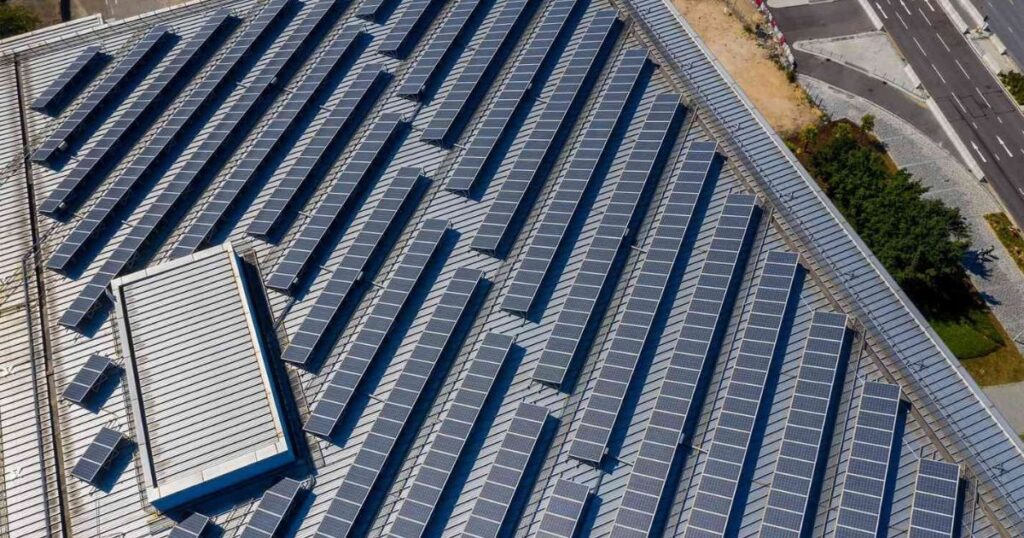
The basic principle is straightforward: solar panels on a commercial property generate electricity during daylight hours, which can first be used by the business to power its operations. If the system produces more electricity than the premises needs at that moment, the surplus can be exported to the grid under the Solar ATAP mechanism.
1. Use More Solar Electricity Directly
The greatest value often comes from using solar electricity within the premises — a factory operating machinery during the day can consume solar energy as it is generated, while an office can use it for air conditioning, lighting, lifts and other electrical equipment. The more electricity a business consumes while its solar system is generating power, the greater the opportunity to reduce electricity purchased from the grid.
2. Export Surplus Solar Energy
When solar generation exceeds the property’s immediate consumption, surplus electricity can be exported to the grid and offset according to the Solar ATAP mechanism — one of the important distinctions between Solar ATAP and a purely self-consumption solar installation. For businesses, the goal shouldn’t necessarily be maximising exported electricity; a properly designed system should be sized around the property’s actual electricity profile.
What Are the Technical Requirements?
Going solar for a commercial property involves more than putting panels on a roof — under Solar ATAP, non-domestic systems may require a technical assessment depending on their capacity and connection requirements, ranging from no assessment fee for smaller systems to a Connection Assessment Study or, for high-voltage connections, a Power System Study.
This is why working with experienced commercial solar services providers is important. A professional solar provider can assess the building, review electricity consumption, determine an appropriate system size and manage the technical and application requirements.
What Else Should Businesses Consider Beyond Installation?
Solar installation is only part of the process businesses should plan for, alongside roof condition and structural suitability, available roof area, historical electricity consumption, maximum demand, electrical infrastructure, inverter selection, monitoring and maintenance, TNB interconnection requirements, and Solar ATAP application and documentation.
According to SEDA, Solar ATAP applicants must appoint a Registered PV Service Provider (RPVSP) for the application submission process — and notably, the solar installation must be fully completed and successfully commissioned before the Solar ATAP application itself is submitted, which is the reverse order of some other solar programmes.
How Much Can Solar Save?
The savings from solar vary considerably from one property to another. There is no universal figure because the result depends on electricity consumption, tariff, solar system size, roof orientation, shading, operating hours and how much generated electricity is consumed on-site.
Over a year, even a few hundred ringgit of monthly savings can add up to several thousand ringgit, and for a business with a much larger electricity bill, the potential annual savings can be considerably greater. However, businesses should look beyond the headline savings figure — a proper financial assessment should consider system cost, expected annual generation, electricity tariff, consumption profile, financing structure, maintenance and projected payback period. In other words, the right question isn’t simply “how much can solar save,” but “how much can solar save for this particular building.”
What Financing Options Does Solar ATAP Offer Businesses?
Solar ATAP provides several routes for businesses to participate: outright purchase through cash, loans or credit cards, alongside Power Purchase Agreements (PPA) and solar leasing, both of which can make solar more accessible to businesses that prefer to preserve capital for other investments rather than committing significant upfront capital.
Power Purchase Agreement
Under a PPA, the investor owns the solar PV system while the site owner pays for the solar energy generated, typically based on a RM/kWh arrangement, with maintenance and performance handled under the arrangement.
Solar Leasing
Solar leasing allows the site owner to use the PV system in exchange for a fixed monthly payment. The system may become the property of the site owner at the end of the lease period, depending on the agreement.

You can learn more about Suria & Sonne’s solar solutions and the company’s approach to solar PV installation.
Why Is Commercial Solar More Than an Electricity-Saving Exercise?
Commercial solar is more than an electricity-saving exercise because a rooftop system can help businesses reduce exposure to conventional electricity costs while making better use of otherwise underutilised rooftop space, and there is also a growing sustainability dimension as businesses facing ESG expectations use renewable energy as part of their wider strategy.
For companies with large facilities, solar can therefore become both an energy-management tool and a long-term business investment.
You can view Suria & Sonne’s solar projects to see examples of completed installations.
Frequently Asked Questions About Commercial Solar Malaysia
Conclusion
Solar ATAP represents an important new chapter for commercial solar in Malaysia. By allowing businesses to generate renewable electricity for their own operations while providing a mechanism for surplus energy to be exported to the grid, the programme gives commercial property owners more flexibility in managing their energy costs.
But installing solar should never be treated as a one-size-fits-all investment — the most effective system is one designed around the building’s electricity consumption, operational requirements, roof conditions and long-term financial objectives. For businesses considering solar, the next step isn’t simply to ask how many panels can fit on the roof, but to determine how much energy the business actually needs and what that generation could be worth over the system’s lifetime. If you’re ready to explore commercial solar for your property, book a consultation with Suria & Sonne.
Considering solar for your property?
Talk to our team about your electricity use and your roof, and we will recommend a system that fits.